>200 Checkpoint Lanes
Ankara Esenboğa Airport is a major international gateway to Turkey's capital, ranking among the country's busiest aviation hubs with over 13 million passengers every year. Within its security operations, manual checkpoints play a critical role in ensuring accurate identity verification and compliance with aviation security standards. As passenger traffic continued to increase, checkpoints faced operational pressure to maintain both speed and accuracy.
To meet this demand, the airport needed a more efficient and consistent approach for ID & document verifications. Conventional manual inspections struggled to provide uniform performance across various document types, including international passports and Turkish national ID cards.
Addressing these challenges required an advanced passport‑reader solution capable of UV‑based forgery detection, RFID‑enabled electronic data validation, and full support for BAC, PA, and AA authentication protocols while integrating seamlessly with the European passport‑reader systems already in place.
As Markland, we deployed our MEPR500+ passport readers across 200 manual security checkpoints, the airport achieved a high‑performance, fully compatible upgrade that significantly enhanced verification speed, accuracy, and overall operational reliability.
Manual inspection workflows required devices capable of:
Capturing anti‑counterfeiting features using UV illumination
Performing RFID‑based electronic data verification
Supporting BAC, PA, and AA authentication protocols
All functions needed to comply with established aviation security standards.
Security checkpoints were required to process multiple document types, including:
International e‑passports
Turkish national ID cards
The solution needed to support both visual data extraction and RFID chip reading across these formats.
Ankara Esenboğa Airport had previously deployed European passport readers, which created requirements for:
Technical compatibility
Workflow consistency
Operational continuity
The new devices had to integrate without affecting inspection speed or altering existing procedures.
The project involved the delivery and activation of 200 devices, including:
Standardized production and quality control
Remote configuration and debugging
On‑site installation across manual checkpoints
Deployment needed to be completed without interrupting daily airport operations.
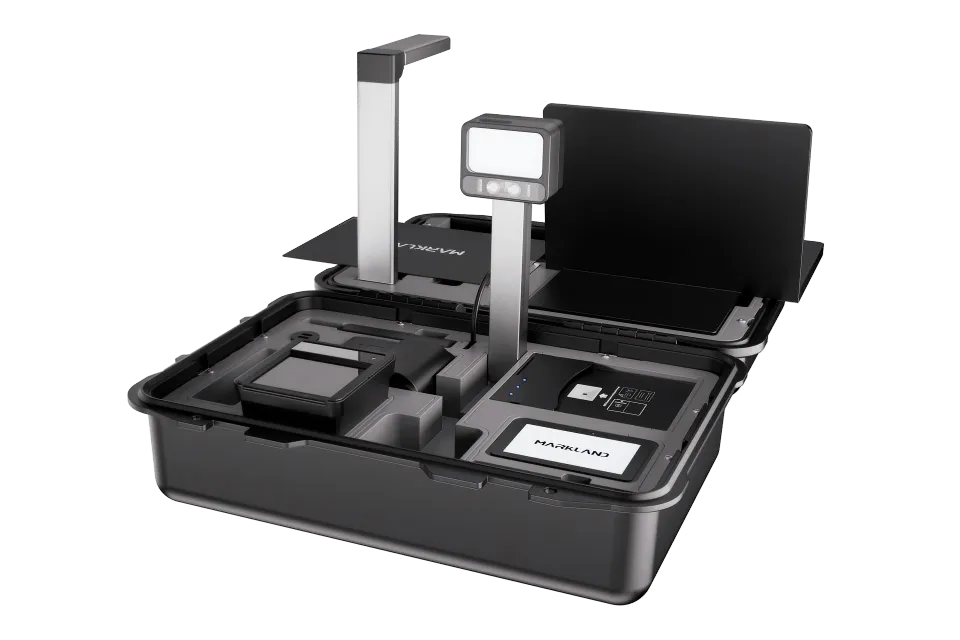
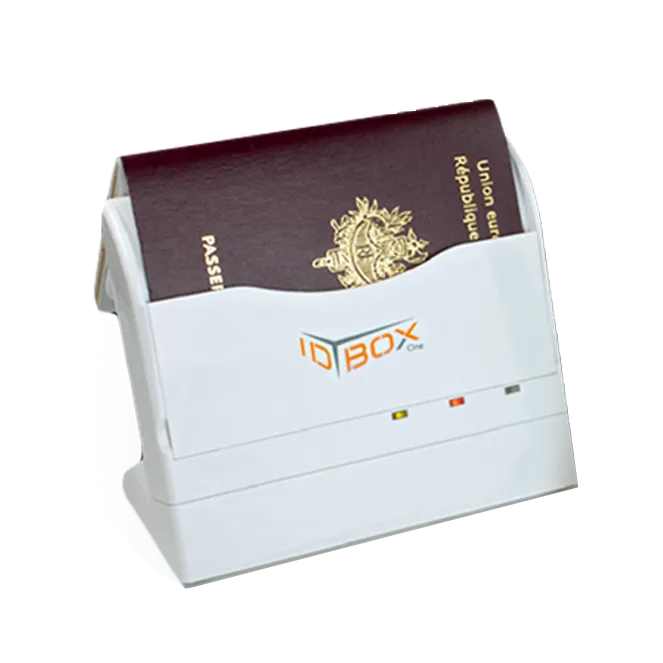
We developed the MEPR500+ as an all‑in‑one platform for manual inspection points, and it consolidated all required verification functions into a single device, including:
365 nm UVA illumination for detecting security features
RFID reading (ISO 14443 Type A/B/C) for electronic data validation
Native support for BAC, PA, and AA authentication
These capabilities ensure compliance with airport security and identity‑verification standards.
We designed the MEPR500+ in accordance with ICAO 9303 standards, enabling accurate processing of international e‑passports and full compatibility with Turkish national ID card chip protocols.
Having 400 DPI imaging, OCR, and integrated RFID, we provide consistent and reliable data extraction across different document formats without requiring changes to existing procedures.
We implemented a structured deployment model to support business continuity. This included controlled production and quality checks, remote configuration and system alignment, and on‑site installation across manual checkpoints. With its plug‑and‑play architecture, the MEPR500+ integrates smoothly into existing systems and allows rapid rollout without disrupting daily operations.
The MEPR500+ met all required functions, including UV security‑feature inspection, RFID chip verification, and BAC/PA/AA authentication. It consistently processed both passports and Turkish ID cards with the accuracy needed for manual security checks.
Smooth System Integration
We integrated the MEPR500+ into the airport's existing passport‑reader ecosystem without workflow changes. Verification speed and accuracy improved, and manual‑inspection errors decreased.
The device delivered stable performance throughout Ankara Airport's manual inspection process. Its reliability was formally recognized by the airport, establishing a strong reference point for similar deployments at other international ports.
 English